
Monthly Market Summary
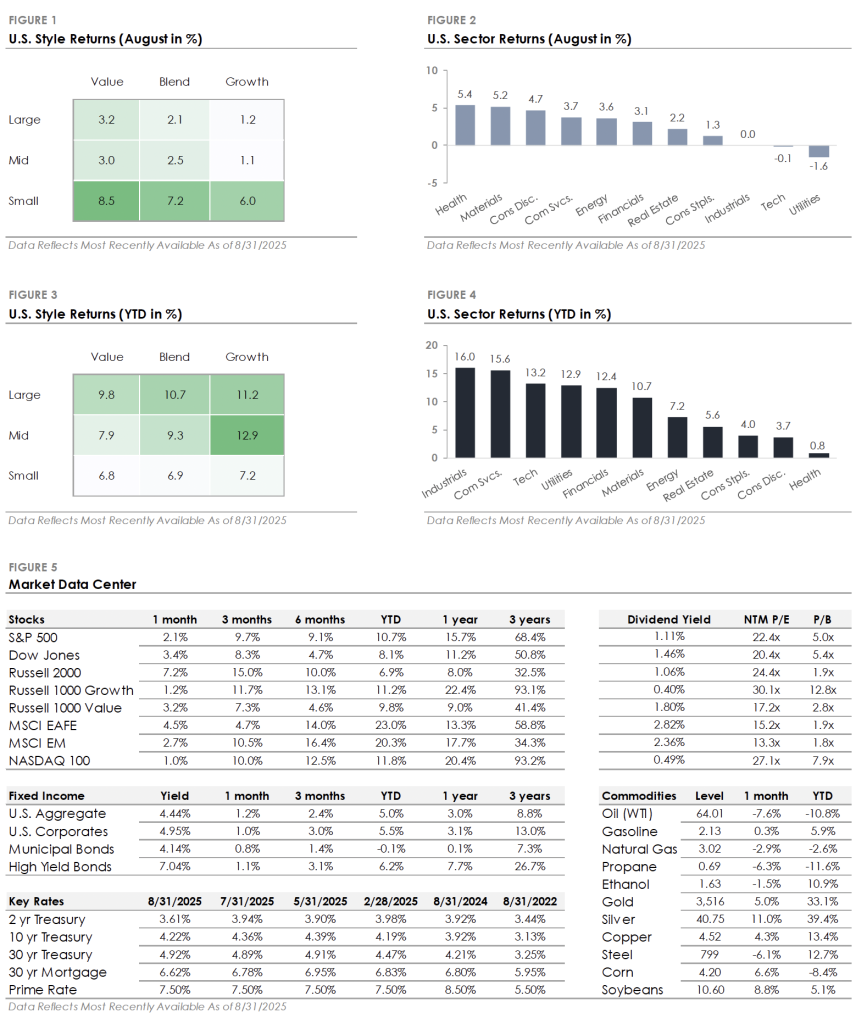
- The S&P 500 Index rose +2.1% in August, bringing its year-to-date returns to +10.7%.
- International stocks outperformed the S&P 500 as the U.S. dollar weakened. Developed Markets gained +4.5%, while Emerging Markets returned +2.7%.
- Bonds traded higher as Treasury yields declined, with the U.S. Bond Aggregate returning +1.2%.
Federal Reserve Prepares to Cut Interest Rates as the Labor Market Softens
The Federal Reserve has kept interest rates unchanged this year due to concerns that tariffs could reignite inflation. This concern, along with strong job growth and low unemployment, gave the central bank time to wait for more data. However, the Fed’s policy stance was tested in early August when the July jobs report showed U.S. employers added fewer jobs than expected and unemployment rose to 4.2%. The report suggested high borrowing costs are weighing on the economy and shifted the focus from inflation risk to slowing economic growth.
These concerns resurfaced three weeks later at the Fed’s annual Jackson Hole meeting, when Chair Powell acknowledged the balance of risks may warrant a policy adjustment. His comments hinted that a rate cut could come as soon as the Fed’s September 17th meeting. The market quickly connected the dots: a softening labor market made it easier for the Fed to pivot and opened the door to a rate cut. Stocks and bonds traded higher in anticipation that the Fed would resume its interest rate-cutting cycle.
Small -Cap Stocks Post Biggest Month of Outperformance Since November ‘24
Small-cap stocks have trailed large caps for most of the past three years. Since the start of 2023, the Russell 2000 index has gained +40%, significantly underperforming the S&P 500’s +75% return. Higher interest rates have weighed more heavily on smaller firms, many of which depend on floating-rate debt to finance their operations and growth. At the same time, a handful of mega-cap tech stocks have delivered strong earnings growth and returns, fueled by the artificial intelligence industry. As investor attention and capital concentrated on these large names, small caps were left behind, resulting in one of the widest valuation discounts to large caps in over 20 years.
The soft July jobs report and Chair Powell’s Jackson Hole remarks shifted the market narrative, with investors expecting a rate cut as soon as September. The Russell 2000 jumped more than +7%, its best month this year, and outperformed the S&P 500 by over +5%. Small caps tend to benefit more from lower interest rates, and rate cut expectations attracted value seekers to small caps’ valuation discount. This isn’t the first time small-cap stocks have rallied, with recent rallies fading as mega-cap tech reclaimed market leadership. Whether this rotation lasts will depend on upcoming inflation and job reports and how the Fed responds, but small caps’ recent strength shows investors are once again testing the waters for a small-cap stock comeback.
This Month In Numbers
Disclosure: This article is distributed for general informational and educational purposes only and is not intended to constitute legal, tax, accounting, or investment advice. The information, opinions and views contained herein are current only as of the date hereof and may be subject to change at any time without prior notice. All investment strategies and investments involve risk of loss.